
Published
How workarounds begin
A receiving team cannot complete a transaction before the next trailer arrives. A customer needs a label the current process does not produce. An interface stops updating shipment status near the carrier cutoff. Someone finds a way to keep the work moving: record the receipt separately, print a label outside the normal flow, or correct the status later. The immediate decision may be reasonable. The problem begins when nobody defines what happens after the emergency.
A workaround can compensate for a system defect, an unsuitable configuration, missing data, or a business requirement that was never designed into the process. It can also compensate for a misunderstanding of the intended workflow. Those causes need different responses. Before treating the extra step as either clever improvisation or poor discipline, establish what prevented the standard process from working and what risk the temporary method introduces.
When temporary becomes permanent
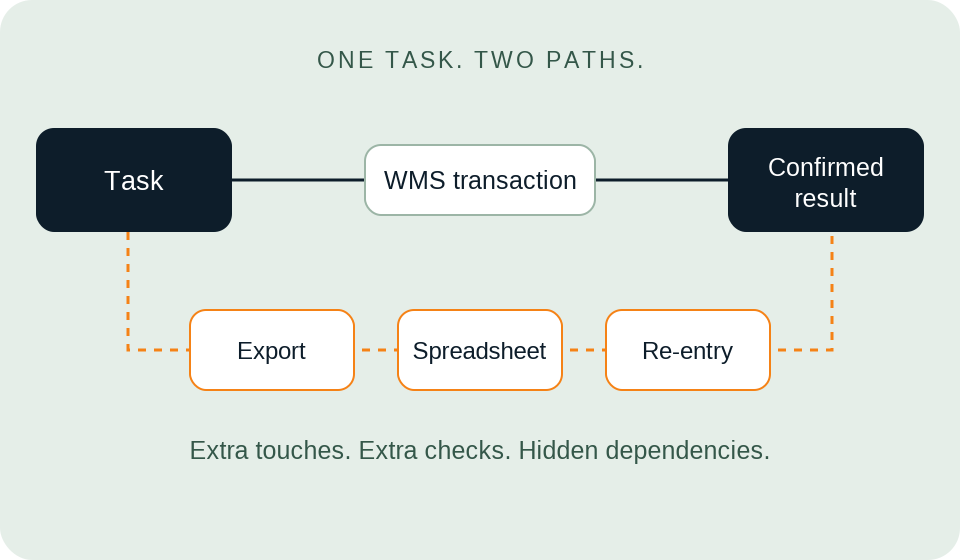
Temporary work rarely announces that it has become permanent. One shift teaches the next to export a report before releasing orders. A supervisor keeps a separate list of inventory exceptions because the shared view is not trusted. A daily reconciliation becomes a named task on the shift checklist. Eventually, a new employee learns the workaround as the process, without ever hearing why it was introduced.
Look for the gap between documented procedure and observed work. Ask people to show the last exception they handled, including the spreadsheets, messages, duplicate entries, and approvals around it. A useful question is: what would stop working if this extra step disappeared tomorrow? The answer reveals dependencies that a walkthrough of the WMS screens alone may miss. An accepted manual control is not automatically a problem; an undocumented dependency with no review date is a different proposition.
The costs nobody measures
Start with touch time, but do not stop there. Count how often the workaround occurs, how many people touch it, and the effort of checking or correcting its output. As an illustration, a four-minute task performed thirty times a day consumes two hours of direct work before any rework or supervision. That is an example, not an industry benchmark. Measure the actual frequency and duration across representative shifts rather than extrapolating from one difficult day.
The less visible costs sit between departments: support investigates mismatches, finance questions a reconciliation, planners wait for a refreshed file, and another shift repeats a correction because the first one was not visible. Separate direct effort from waiting time, error recovery, and business consequences such as missed cutoffs or disputed shipments. Avoid adding overlapping estimates twice. Also record person-dependency: a process that works only when one experienced employee is present has a continuity exposure that labor minutes alone cannot describe.
Operational debt becomes technical debt
Operational debt is the recurring effort and risk accepted to keep the process running. Technical debt is the additional difficulty of maintaining or changing the solution. A workaround can create both. Consider a spreadsheet used to alter an export before another system imports it. The warehouse now owns an extra daily task, while IT has an unofficial transformation to understand, secure, test, and preserve whenever either system changes.
These dependencies are easy to miss in an enhancement or upgrade assessment. A renamed field can break a macro; a new transaction sequence can invalidate a manual reconciliation; a recovery script can rely on assumptions that no longer hold. Map the whole path, including off-system steps, before estimating a change. Record who owns each transformation, which version is in use, and how failure is detected. Otherwise, a seemingly small improvement can carry an unexpectedly large regression and support burden.
Why employees keep using them
People are rewarded for getting orders out, not for proving that a standard workflow is theoretically correct. If the official process has failed them before, an experienced operator may trust a familiar spreadsheet more than a newly corrected screen. Training gaps can reinforce that choice, but so can a genuine design mismatch: a procedure may be technically valid while adding steps that do not fit the pace or sequence of the floor.
Treat continued use as evidence to investigate, not an invitation to blame the team. Observe the task under normal pressure and ask what the workaround provides: speed, visibility, control, confidence, or a way to recover. A replacement needs to preserve the useful outcome while removing the unnecessary burden. Demonstrate it with the people who perform the work, explain the approved exception path, and make help accessible during the transition. Removing a file before the replacement is dependable usually moves the workaround somewhere less visible.
Identify the workarounds that matter most
Build a short register rather than a collection of complaints. For each workaround, capture the trigger, frequency, affected transactions, manual effort, error exposure, downstream impact, and owner. Include when it started and why it still exists. Review the register with operations and IT together: the most time-consuming step on the floor may not be the one creating the greatest inventory or shipment risk.
Prioritize using both routine burden and potential consequence. A frequent duplicate entry can justify attention through accumulated effort. An infrequent correction that can create a duplicate shipment or undermine traceability may deserve earlier action despite consuming fewer hours. Consider how quickly a failure would be detected and whether recovery is understood. Do not let a single numerical score obscure a serious control weakness. Select a manageable first group with clear evidence, ownership, and an achievable validation scope.
From workaround to sustainable process
Trace the cause before choosing the remedy. If a shipment status needs manual correction, determine whether the source event is missing, a message is delayed, a mapping is wrong, or the receiving system rejects the update. Automating the correction without understanding the failure may make an unreliable process run faster. The appropriate response might be a configuration adjustment, better master-data ownership, a process change, targeted training, or a supported integration improvement—not necessarily new code.
Define the intended result and acceptance conditions before changing anything. Test normal transactions, exceptions, retries, duplicate prevention, and reconciliation in an authorized non-production environment. Include downstream systems and the people who own the next step. Pilot within a controlled scope, compare results with the baseline, and retain an agreed recovery path. Retire the workaround only after the replacement is stable and users can handle expected exceptions; document the decision and remove obsolete instructions so the old method does not quietly return.
Make continuous improvement part of ownership
Give each retained workaround a business owner, a review date, and a reason for acceptance. Some manual steps will remain because the volume is low, the control is useful, or the cost of replacement is not justified. Make that a conscious operating decision, with instructions and limits, rather than an unresolved promise. Ownership should sit with the process, not only with the person who originally created the file or script.
Review new workarounds alongside incidents and change requests. After a release or peak period, ask which extra steps appeared and whether they are still needed. Track whether the chosen improvements actually reduce repeat work without transferring effort to another team. When a workaround is retired, check later shifts and sites for continued use and capture what prevented the standard process from succeeding. The aim is not a warehouse with no exceptions. It is an operation that can see, evaluate, and reduce the hidden effort required to handle them.
A workaround may solve today's problem, but its long-term cost can exceed the original issue.
Use with your team
Working checklist
Checks are temporary and are not saved or submitted. Use Print / save PDF for your working copy.
Educational guidance. Apply it to your product, version, operating conditions, and agreed controls; it is not a project-specific solution design.